Welcome to the New Academic Year
Dear members of the Columbia community:
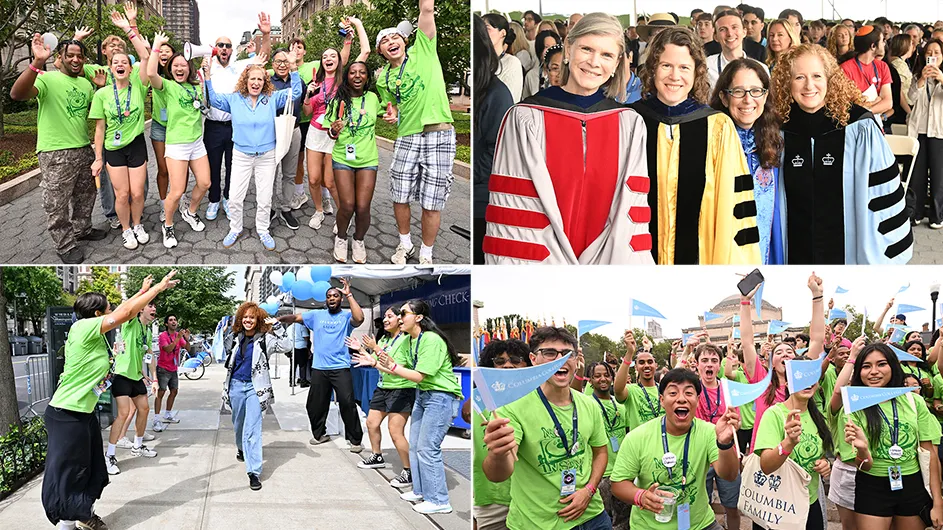
On this first day of classes, I am delighted to welcome all of you to a new academic year—and to offer an especially warm welcome to those for whom this is your first fall at Columbia, as it is mine.
To those who are just joining us, those who have returned from summers spent all across the globe, and those who never left, it is wonderful to have everyone here together. I hope you will take the beginning of the school year to reconnect with old friends, make new ones, and reflect upon what it means to be part of this remarkable community.
I also want to offer a special welcome to our international students and scholars. Columbia has long been a university deeply connected to the world, and our international community is essential to who we are. You bring perspectives, experiences, ideas, and expertise that enrich our classrooms and laboratories, deepen our scholarship, and strengthen both Columbia and New York City. I recognize that this is a challenging and uncertain moment for our international community. Please know how much we care about your ability to learn, discover, teach, and thrive at Columbia.
I arrived on campus on July 1, and have spent the last two months learning as much as I could about this extraordinary place. I have met with students, faculty, and staff from across our campuses, schools, and departments, as well as alumni and community members, and those conversations will continue. You have shared both your hopes and your concerns, your favorite parts of our University, and your ideas for our future. These conversations have already impressed upon me just how deeply Columbians care about our University and its mission.
At our undergraduate convocations last week, I reminded our incoming students that the beginning of an academic year is a celebration of continuity as well as an act of renewal. Generations of Columbians have studied here, dating back to students who gathered in a small schoolhouse in Lower Manhattan in 1754. Our students enter classrooms and fields of study shaped by those who arrived before them. Our faculty, too, build on the discoveries of their predecessors. And each generation takes what came before it and questions it, tests it, reimagines it, and, importantly, pushes it forward and makes it its own.
Great universities like Columbia are places of productive tension—tension between tradition and innovation, certainty and doubt, established knowledge and new ideas, agreement and disagreement. That tension is essential to our intellectual life. It asks us to encounter ideas that challenge our assumptions, to defend our own thinking with rigor and evidence, and to remain open to the possibility that someone else might change our minds. These forms of engagement are often exhilarating and sometimes uncomfortable, but it is through them that knowledge advances. Productive tension is at its best when it also occurs in an environment of mutual respect and engagement within a shared community, when we recognize the dignity of those who see the world differently from us, and when we bring curiosity before judgment, both to our academic endeavors and to one another.
Great universities like Columbia are places of productive tension—tension between tradition and innovation, certainty and doubt, established knowledge and new ideas, agreement and disagreement. That tension is essential to our intellectual life.
In the months ahead, I will continue to listen and to learn from all of you. Later this fall, I will share more about institutional priorities and areas where I believe Columbia has particular opportunities and important work ahead. Some questions and themes are already emerging: How should Columbia engage with, and respond to, the disruption, opportunity, and challenge AI poses? What does, and what should, it mean to be Columbia University in the City of New York? And how can we strengthen the experience of being part of Columbia, building greater connection across our University, making our institution easier to navigate, and creating the conditions for students, faculty, and staff to flourish.
These questions look toward our shared future; they also build on the remarkable work already taking place across Columbia. Recently, we have developed a first-of-its-kind model of how cancers spread to other organs; traveled above Antarctica searching for signs of dark matter; investigated how artificial intelligence models interpret artistic style; explored the relationship between architecture and the organization of knowledge; recovered a largely forgotten linguistic system from medieval Vietnam; helped shed new light on the causes behind the devastating floods in Nepal; and brought to the stage a Tony Award-winning play exploring second-wave feminism in 1970s Ohio.
These discoveries and creative works span medicine, physics, computer science, architecture, history, language, and the arts, and they represent only a small fraction of the work taking place here. They remind us that discovery often does not follow a single path and that we cannot always know in advance where an idea, an experiment, a disagreement, or a question might lead.
I am so excited to see what our community will discover, create, debate, teach, and accomplish in the year ahead. I look forward to meeting many more of you in the coming weeks and months. Welcome, again, to all of you.
Sincerely,
Jennifer L. Mnookin
President, Columbia University in the City of New York