A First Day Message From President Jennifer L. Mnookin
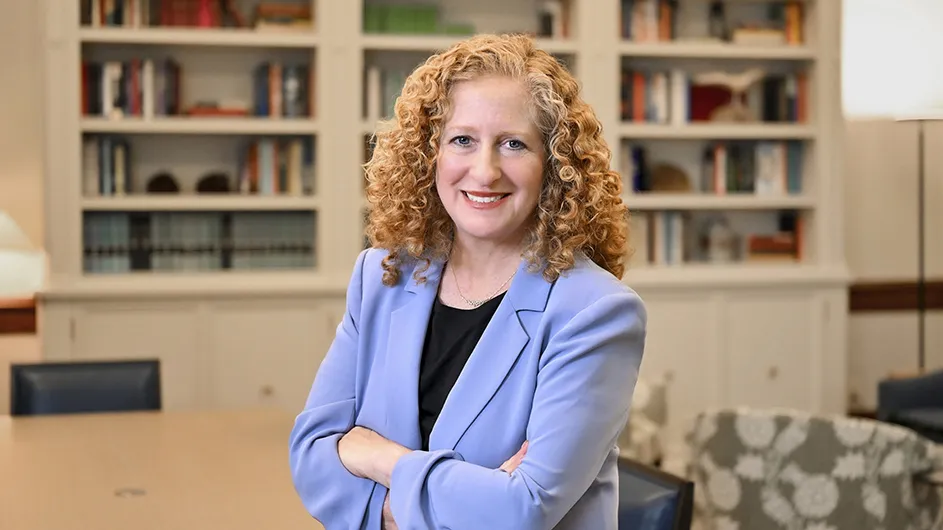
Dear members of the Columbia community,
Today I am delighted to officially join Columbia University as your 21st president.
Thank you to everyone who has welcomed me so warmly already. I look forward to meeting many more of you in the weeks and months ahead—and to making plenty of return visits to the Hungarian Pastry Shop, a favorite of mine ever since my first visit to Columbia’s campus more than 40 years ago.
I have long admired Columbia as a University of extraordinary intellectual energy: a place that asks difficult questions, pursues discovery across the full range of human inquiry, and draws strength from the dynamism of New York City, to which we are so deeply linked.
Related Content
Complexity is one of Columbia’s (and New York City’s) great strengths. We are a University where many disciplines, identities, perspectives, methods, and traditions meet and challenge one another. At its best, Columbia does not flatten those differences. It engages them in the pursuit of new knowledge and deeper understanding. It invites people to test assumptions, encounter unfamiliar ideas, sharpen their thinking, and work constructively with others who may see the world differently.
This matters, especially now. Universities across the country are being asked fundamental questions about their purpose and value. Columbia’s answers cannot simply be asserted or assumed. They must be demonstrated through the quality of our teaching, the strength of our research and scholarship, the seriousness of our intellectual life, the opportunities and experiences we create for our students, and the contributions we make to New York City, our nation, and the world. We will need to hold fast to what is essential about our University while also asking, honestly and rigorously, where we must adapt in order to serve that mission more fully.
As a scholar of legal evidence, I have spent much of my career thinking about how we know, how claims are tested, how evidence is interpreted, and how we distinguish assertion from understanding. Across the full range of academic disciplines, questions of evidence, interpretation, and rigorous inquiry are central. But the kinds of evidence and methods of inquiry that matter in medicine, philosophy, engineering, history, law, the arts, the humanities, the social sciences, and the natural sciences are not all the same. Great universities like ours must insist on intellectual seriousness while recognizing the varied ways serious inquiry proceeds. That means balancing rigor with open-mindedness and shared purpose with pluralism.
Navigating productive tensions like these is part of what makes universities so vital. And Columbia has known such tensions from the beginning. We began as King’s College, a loyalist institution chartered by the Crown that went on to educate many of the founders of our early Republic. Columbia’s history is not simple. Complexity, and the capacity to grapple productively with it, is part of our shared inheritance and is central to Columbia’s strength. These tensions help make the work of our University more searching, more creative, and more consequential.
As I begin serving as president, I will be listening and learning widely. I will seek out a broad range of perspectives, welcome respectful disagreement and unexpected collaboration, and work to uphold the values that define the greatest academic institutions: excellence, open inquiry, academic freedom, intellectual honesty, mutual respect, creative imagination, dedication to our students, and a deep commitment to teaching and learning.
One Columbia story has stayed with me as I have been preparing for this first day. Early in our University’s history, Columbia is said to have lent its first telescope to George Washington during the Revolutionary War. He used it in the Battle of Long Island, and the telescope, alas, never made its way back to Columbia.
A telescope expands the horizon of what can be seen. Universities do something similar. They help us look farther, think more deeply, and see more clearly. And from the beginning, Columbia’s pursuit of knowledge has been connected to public purpose. Across nearly three centuries, Columbia has done this work in countless ways. Sometimes it involves instruments that quite literally expand what human beings can see and measure. But insight and discovery can just as readily begin in an archive or a studio, a clinic or a classroom.
Today, tomorrow, and every day that follows, thousands of people across Columbia will continue asking questions whose answers we do not yet know and whose significance we cannot fully predict. Columbia’s work belongs to no single discipline, school, or campus. It is carried forward every day by faculty, students, staff, alumni, clinicians, researchers, and partners here in New York City and around the globe.
I am grateful to Claire Shipman for her service as acting president, for so generously welcoming me during this transition, and for leading over the past 15 months with steadiness, integrity, and deep care for Columbia during a challenging and consequential time. I am grateful as well to the Trustees for their confidence and support. And I want to thank all of you, whose commitment, curiosity, and dedication sustain and propel this great University. I very much look forward to working with all of you.
I arrive with deep respect for Columbia’s history, with clear eyes about the challenges before us, and with great confidence in what our University can accomplish. I am honored to join this extraordinary community and eager for us to begin the work ahead together.
Sincerely,
Jennifer L. Mnookin
President, Columbia University in the City of New York