President Mnookin Welcomes New Undergraduates in Her First Convocation Remarks
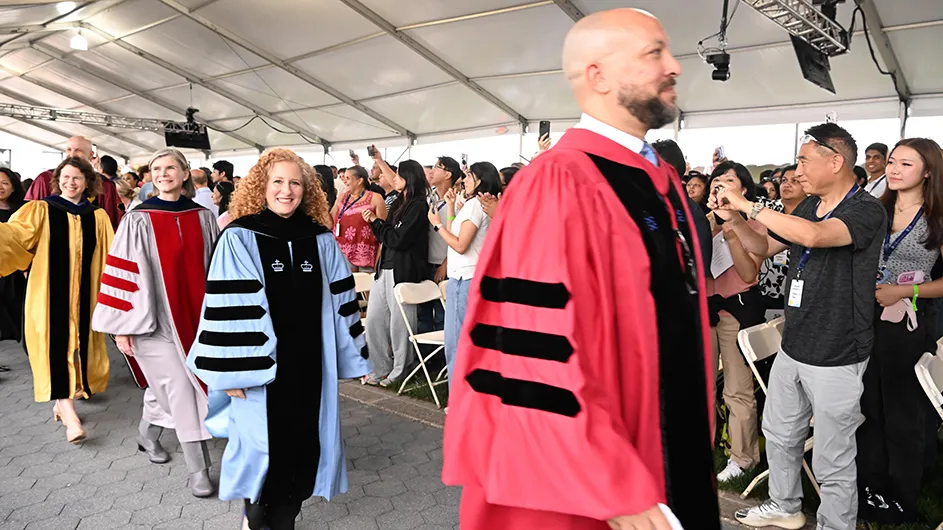
Jennifer L. Mnookin began her first academic year as Columbia’s president by welcoming the incoming Columbia College, Columbia Engineering, and Columbia School of General Studies classes at their respective Convocation ceremonies. These ceremonies, which took place on August 30 and 31, 2026, took place ahead of the start of New Student Orientation for Columbia undergraduates.
2026 Convocation Remarks
August 30, 2026
It is my great pleasure today to welcome the students, families, and friends of the class of 2030.
I feel a particular kinship with this class, because I am also new to Columbia. You are the first class I have the privilege to welcome. And while you are going through NSOP, or the New Student Orientation Program, I like to think I’ve been going through “NPOP”—the New President’s version. I’ve had the chance to meet several of you today, as you were moving in, and I am delighted to begin my own Columbia journey, not just alongside you, but with you.
As a parent of two relatively recent college graduates myself, I understand something about how this moment must feel to all the parents and loved ones here today: Thank you for entrusting us with these amazing young people you have raised. And students, let’s give a very warm round of appreciation to your parents and loved ones for all the ways that they supported you and helped you get here, with us, today.
This is a significant moment. Today we celebrate both a beginning and continuity.
You are in this extraordinary city, experiencing your first days at Columbia, and embarking on a path traveled by your predecessors for more than 270 years. And just like those who have come before you, soon, you’ll be enrolled in classes like Literature Humanities, or LitHum, a Core course that has been taught here in one form or another for over a century.
It’s a journey others have made before, courses others have taken before—and yet the outcome is never the same. That is because you are the variable. You have the opportunity to see things anew, to invent and create anew, to forge new and original connections—among texts, among insights, and among one another. It’s heady stuff.
And as you contemplate where your journey here might lead you, I imagine you might have a mix of emotions. Some of you—maybe many of you—are exhilarated, proud, excited, ready to get started. And others, if we’re being honest, might be feeling a little nervous. Many of you, perhaps most of you, may be feeling all of these emotions at once. Excited, yes, but perhaps also a bit intimidated by the accomplishments of our alumni, by the high bar we set for our learning, and the high standards we have for our impact.
You have already demonstrated you have what it takes to be here. And I hope you take comfort and confidence in the fact that our faculty and staff are committed to helping you succeed here and wherever this journey takes you.
And if you are feeling nervous, and even a little daunted, you can embrace those feelings as well. Allow them to fuel your own intellectual aspirations. Use them to aim high, and to help you hone your questions and broaden your curiosity across the full spectrum of human inquiry. Remember that the pathbreaking presidents and prime ministers, Pulitzer Prize winners and Nobel laureates, inventors of cures, creators of art, and transformational figures across so many areas of human pursuit who walked this campus before you—well, they were once first-year students themselves, brand new to Columbia, and almost certainly a little bit nervous as they readied themselves for the beginning of the semester, not knowing exactly what lay ahead.
And that, I hope, is more inspiring than scary. Because there are endless possibilities that await you as you start your journey here.
I was reminded of what makes a Columbia journey so special just a couple of weeks ago.
I was waiting for some pan-fried dumplings at a little restaurant only a few blocks away, and a couple of Columbia undergraduates recognized me and said hello. One was from Brooklyn, one from London. One was a student-athlete, one wasn't. One was a computer science major; the other, if memory serves, was a social scientist. Movies came up in our conversation—they had just seen the new Spider-Man, which I haven’t seen. I asked them if they’d seen The Odyssey, which has several of the same cast members, and which I’d seen just the week before. They grinned and said: “Well, of course we’ve seen The Odyssey. We’re Columbia students!”
That led to a remarkably engaging conversation about the differences between Christopher Nolan’s version and the text. They shared with me some of their ambivalence about the modern updating and the many divergences between the film and Homer’s version. And while they appreciated that the film was attracting a large audience, they felt they were able to fully understand it only because of their deep engagement with the original.
It struck me that this was a very Columbia conversation: three people from different backgrounds and even different countries, with different areas of passion and expertise, building on a foundation of shared knowledge while waiting for our lunch orders, on Broadway.
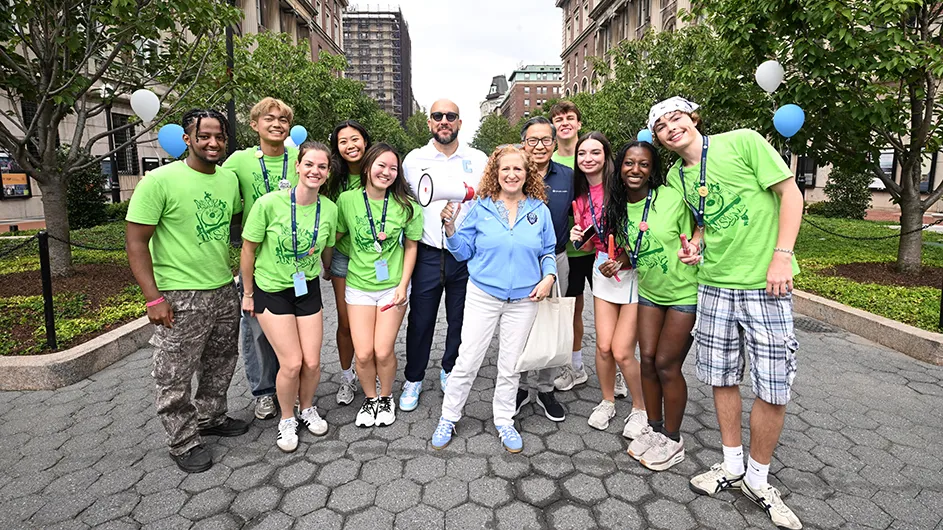
As I am sure you know, The Odyssey has long been taught as part of our Core curriculum, which began more than a hundred years ago. This is why any Columbia student from any era can engage with it. Same with works from Gilgamesh to the Gospels, by authors from Plato to Toni Morrison, Shakespeare to Jane Austen. Musicians from Igor Stravinsky to Nina Simone. Artists from Michelangelo to Monet. These great works make up our Core. That Core experience is a key foundation of your shared journey.
The Core builds shared “habits of mind,” the term you’ll learn in the Frontiers of Science course that refers to best practices for scientific thinking; a skill that will last far beyond your time at Columbia and provide the tools to engage deeply, think critically, and ask fundamental questions no matter the text or the issue at hand. And these practices are all the more vital in this time of rapid technological change and deep societal disagreement.
The Core also builds a powerful sense of community and connection with your classmates, with the people sitting around you right now.
You may be feeling some urgency to find “your people.” The friends you will make for life. And you will. However, you may also find that “your people” might not be who you initially expect them to be. This may be one of the most diverse communities you’ll ever be a part of.
There are almost 1,700 first-year students this year. You hail from 83 different countries and 49 U.S. states. (To answer the unasked question: Wyoming—though we have many alumni from that wonderful state!) One out of every five of you is part of the first generation in your family to go to college—and let’s all give our first-generation students a big congratulatory cheer.
You come from big cities and small towns. For some of you, this is your first time in Manhattan; for others, New York City is the only place you’ve ever lived. Some of you went to high schools where your graduating class was about as big as this group or even bigger, and for others, this class may be larger than the entire population of your hometown. You are aspiring physicians and philosophers, artists and engineers, historians and mathematicians—and so much more.
Together, you bring a diversity of backgrounds, as well as a diversity of experiences. What this means is that there are very likely others in your class who have a similar background to you, and you may be drawn to them. But one of the great opportunities you have in a place like this is to really get to know people with very different life experiences thus far, and to have the chance to grow together. Seek that out. Embrace it.
Over these next days, weeks, and years have conversations. If you find areas of agreement, great. And when you disagree, as you surely sometimes will and even should, disagree productively. True learning comes from productive tension, engaging with one another and learning from disagreement. At minimum, you’ll sharpen your own case and strengthen your own convictions. You might even change your mind, try a new approach to an old problem, or find a collaborator in a different discipline.
We are a University that derives new knowledge from different approaches and deeper understanding from different opinions. These tensions make us better. They make our University better. And ultimately, they make our world better.
Your epic journey begins today, though, unlike The Odyssey, your journey should take much less than a decade—at least this leg of it.
Like Odysseus, you will face tests and challenges. You will have hard days—and you will get through them. You will also encounter moments of pure magic when ideas fly and you achieve things you never thought possible. There’s something so special—so Columbia—about that. And you have the chance to pursue all of this here in New York City, with its unmatched diversity, dynamism, and nearly infinite opportunities for exploring whatever interests you.
I started my remarks today with a story of something that happened a few weeks ago. But one thing I have already been reminded of, again and again, in my short time here is how much history permeates our institution. It’s a history that offers us some perspective not only on the lessons of our past, but in the possibilities of our future.
So, I want to conclude with a story from early in that long and proud history. It’s about a young student who came to the predecessor of Columbia, King’s College, much like you—eager to learn and grow. As he started his journey, he thought he would become a medical doctor and spent much of his time going to anatomy lectures.
His name? His name was Alexander Hamilton.
As we all know, ultimately, he discovered a new passion: politics. And while he was still a teenager, and a Kings College student, he embraced a little “productive tension,” writing two pamphlets that served as scathing rebuttals to a prominent loyalist figure of the time. And we all know the story that then unfolded. Hamilton, like many of Columbia’s students over the years, did not come to Columbia knowing exactly where his journey would take him. And he did not leave with the same aspirations he had when he entered.
This story reminds us of our shared history and the remarkable truth that we are an institution that predated America—and in many ways, shaped America. But it equally reminds us to embrace curiosity and to be open to unexpected new paths and new possibilities.
And remember, while before the American Revolution, this was Alexander Hamilton’s university, as of today, it is YOUR university. Wherever you are from, whatever you hope to study, whatever your passions—you belong here. And I hope you simply let yourselves feel the joy of this day, this moment. It’s an extraordinary privilege to be here, for you and me alike. And I am delighted that our odysseys here are beginning together.
Welcome to Columbia University!
August 31, 2026
It is my great pleasure today to welcome the newest Columbia General Studies students and their families and friends.
I feel a particular kinship with this class, because I am also new to Columbia. You are the first class I have the privilege to welcome. And while you are going through NSOP, or the New Student Orientation Program, I like to think I’ve been going through “NPOP”—the New President’s version. I look forward to comparing notes. I am delighted to begin my own Columbia journey, not just alongside you, but with you.
And students, let’s give a very warm round of appreciation to those family and friends who have helped you get here, with us, today, some of whom are physically here today with you and others of whom are with you in spirit.
This is a significant moment. Today we celebrate both a beginning and continuity. You are in this extraordinary city, experiencing your first days at Columbia, and embarking on a path traveled by your predecessors for more than 270 years. And just like those who have come before you, soon, you will be enrolled in classes like Literature Humanities, or LitHum, a Core course that has been taught here in one form or another for over a century.
It’s a journey others have made before; courses others have taken before—and yet the outcome is never the same. That is because you are the variable. You have the opportunity to see things anew, to invent and create anew, to forge new and original connections—among texts, among insights, and among one another. It’s heady stuff.
And as you contemplate where your journey here might lead you, I imagine you might have a mix of emotions. Some of you—maybe many of you—are exhilarated, proud, excited, ready to get started. And others, if we’re being honest, might be feeling a little nervous. Many of you, perhaps most of you, may be feeling all of these emotions at once. Excited, yes, but perhaps also a bit intimidated by the accomplishments of our alumni; by the high bar we set for our learning and the high standards we have for our impact.
You have already demonstrated you have what it takes to be here. And I hope you take comfort and confidence in the fact that our faculty and staff are committed to helping you succeed here and wherever this journey takes you.
And if you are feeling nervous, and even a little daunted, you can embrace those feelings as well. Allow them to fuel your own intellectual aspirations. Use them to aim high, and to help you hone your questions and broaden your curiosity across the full spectrum of human inquiry. Remember that the pathbreaking presidents and prime ministers, Pulitzer Prize winners and Nobel laureates, inventors of cures, creators of art, and transformational figures across so many areas of human pursuit who walked this campus before you—well, they were once brand new to Columbia themselves, and almost certainly a little bit nervous as they readied themselves for the beginning of the semester, not knowing exactly what lay ahead.
And that, I hope, is more inspiring than scary. Because there are endless possibilities that await you as you start your journey here.
I was reminded of what makes a Columbia journey so special just a couple of weeks ago.
I was waiting for some pan-fried dumplings at a little restaurant only a few blocks away, and a couple of Columbia undergraduates recognized me and said hello. One was from Brooklyn, one from London. One was a student-athlete, one wasn’t. One was a computer science major; the other, if memory serves, was a social scientist.
Movies came up in our conversation—they had just seen the new Spider-Man, which I haven’t seen. I asked them if they’d seen The Odyssey, which has several of the same cast members, and which I’d seen just the week before. They grinned and said: “Well, of course we’ve seen The Odyssey. We’re Columbia students!”
That led to a remarkably engaging conversation about the differences between Christopher Nolan’s version and the text. They shared with me some of their ambivalence about the modern updating and the many divergences between the film and Homer’s version—and while they appreciated that the film was attracting a large audience, they felt they were able to fully understand it only because of their deep engagement with the original.
It struck me that this was a very Columbia conversation: three people from different backgrounds and even different countries, with different areas of passion and expertise, building on a foundation of shared knowledge while waiting for our lunch orders, on Broadway.
As I am sure you know, The Odyssey has long been taught as part of our Core curriculum, which began more than a hundred years ago, and which is a foundational part of the General Studies education, just as it is for the College and the School of Engineering. This shared history is why any Columbia student from any era can engage with works like The Odyssey. Same with works from Gilgamesh to the Gospels, by authors from Plato to Toni Morrison, Shakespeare to Jane Austen. Musicians from Igor Stravinsky to Nina Simone. Artists from Michelangelo to Monet. These great works make up part of our Core. And that liberal arts experience is a key pillar of the shared journey for nearly all of you.
The Core builds shared “habits of mind” and intellectual tools that will last far beyond your time at Columbia as you engage deeply, think critically, and ask fundamental questions no matter the text or the issue at hand. And these practices are all the more vital in this time of rapid technological change and deep societal disagreement. The Core also is one component in creating a powerful sense of community and connection with your classmates, with the people sitting around you right now. And those of you in the post-bac program: While the Core may not be part of your intellectual experience here, you too will find both intellectual connections and a great community. And nothing keeps you from reading The Odyssey on your own if you’re so inspired!
As you begin your time here at Columbia, you may be feeling some urgency to find “your people.” The people you connect with easily, and people who may well become lifelong friends. And you will find them. However, you may also find that “your people” might not be who you initially expect them to be.
The School of General Studies is one of the most remarkable parts of this University. I was familiar with it well before joining the University as president—in fact, my cousin graduated from GS. It is an incredible place, where people with markedly different experiences come together—each finding their path to this Columbia undergraduate education on their own time and in their own way. This may be one of the most diverse communities you’ll ever be a part of.
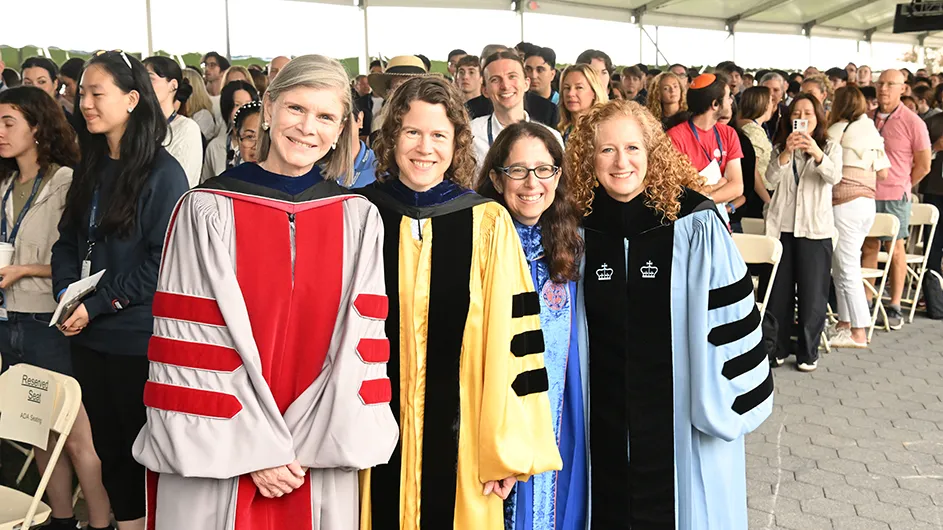
In this class alone, your ages range from 17 to 70. You come from nearly 60 countries and 30 US states. We have more than 140 US military veterans, and veterans from a number of other countries as well, and I thank you for your service. We have very recent high school graduates, community college graduates, and professionals with deep experience in industries ranging from accounting to agriculture, construction to entertainment, journalism to pharma, sports to theater, and so much more. About 200 of you are in our dual degree programs, impressively earning two BA degrees over only four years. And nearly 70 of you are in GS’s unique post-bac premed program, focused on taking the hard science courses necessary for medical school.
Notably, just over 30 percent of you are first-generation college students—and if you are in that group, please raise a hand and let us recognize you and specially welcome you!
Every one of you adds depth and breadth to the GS population and to the University community. What a remarkably rich tapestry to join and to travel with and learn from over the coming years.
One of the great opportunities you have in a place like this is to really get to know people with very different life experiences thus far, and to have the chance to grow together. General Studies may very well offer among the very best opportunities at Columbia to do exactly that.
Seek that out. Embrace it, among one another, and with your fellow undergraduate students in Columbia College and Engineering as well.
Over these next days, weeks, and years have conversations. If you find areas of agreement, great. And when you disagree, as you surely sometimes will and even should, disagree productively. True learning comes from productive tension, engaging with one another, and learning from disagreement. At minimum, you’ll sharpen your own case and strengthen your own convictions. You might even change your mind, try a new approach to an old problem, or find a collaborator in a different discipline.
We are a University that derives new knowledge from different approaches and deeper understanding from different opinions. These tensions make us better. They make our University better. And ultimately, they make our world better.
Your epic Columbia journey begins today, though, unlike The Odyssey, it won’t take 10 years. Like Odysseus, you will face tests and challenges. You will have hard days—and you will get through them. You will also encounter moments of pure magic when ideas fly and you achieve things you never thought possible. There’s something so special—so Columbia—about that. And you have the chance to pursue all of this here in New York City, with its unmatched diversity, dynamism, and nearly infinite opportunities for exploring whatever interests you.
I started my remarks today with a story of something that happened a few weeks ago. But one thing I have already been reminded of, again and again, in my short time here, is how much history permeates our institution. So, I want to conclude with a story from early in that long and proud history. It’s about a young student who came to the predecessor of Columbia, King’s College, much like you, eager to learn and grow. As he started his journey, he thought he would become a medical doctor and spent much of his time going to anatomy lectures.
His name? His name was Alexander Hamilton.
Ultimately, he discovered a new passion: politics. And while he was still a teenager, and a King’s College student, he embraced a little “productive tension,” writing two pamphlets that served as scathing rebuttals to a prominent loyalist figure of the time. And we all know the story that then unfolded. Hamilton, like many of Columbia’s students over the years, did not come to Columbia knowing exactly where his journey would take him. And he did not leave with the same aspirations he had when he entered.
This story reminds us of our shared history and the remarkable truth that we are an institution that predated America—and in many ways, shaped America. But it equally reminds us to embrace curiosity and to be open to unexpected new paths and new possibilities.
And remember, while before the American Revolution, this was Alexander Hamilton’s university, as of today, it is YOUR university. Wherever you are from, whatever life experience has led you to this point, whatever you hope to study, whatever your passions—you belong here. And I hope you simply let yourselves feel the joy of this day, this moment.
It’s an extraordinary privilege to be here, for you and me alike. And I am delighted that our odysseys here are beginning together.
Welcome to Columbia University!