Claire Shipman's 2026 Commencement Address to Columbia's Graduate Students
Acting President Claire Shipman delivered remarks to Columbia’s graduating class at two University Commencement ceremonies on May 20, 2026—one for graduate students, shared here, and one for undergraduate students.
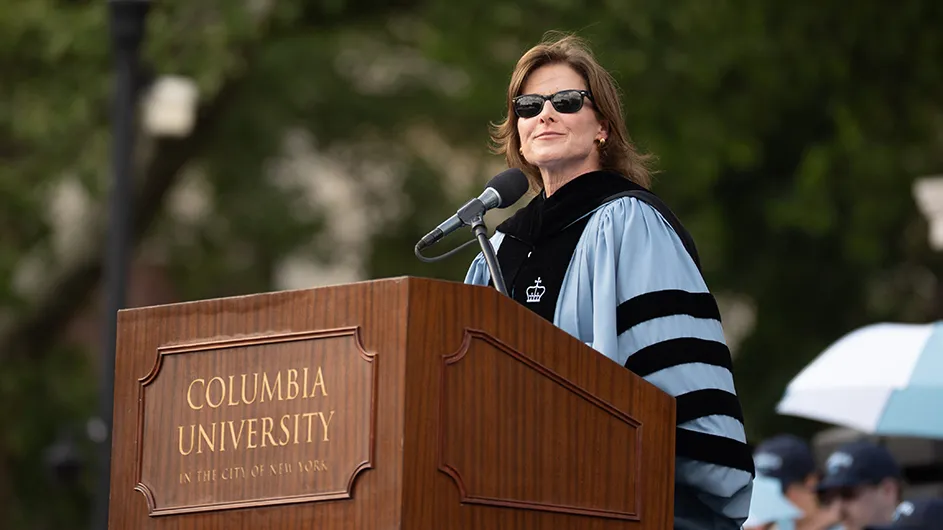
Welcome, graduates, on this steamy Commencement Day. And welcome to all of the families and loved ones who have shepherded these soon-to-be degree-holders to this milestone moment. A round of applause please for your parents, friends, and supporters.
And how about our Law School graduates, our Medical School graduates, Nursing School, Public Health, Dental School, Journalism School, our School of Social Work, the Graduate School of Arts and Sciences, Engineering, Teachers College, Architecture, SIPA, the School of the Arts, Climate School, Professional Studies, and Business School graduates.
We have a surprise coming up … a unique ensemble act today.
You will hear from one of our quite special faculty members who exemplifies what Columbia offers, to our students and to the world.
And, later on, one of our honorary degree recipients will mark this passage for you with his own infectious brand of joy and inspiration.
For 272 years now, Columbia has been sending graduates into the world. Our institution was an incubator—for the ideas and for the leaders—central to the creation of this nation, 250 years ago this summer. Many of those same leaders would come back a few years later, Alexander Hamilton and John Jay among them, to transform King’s College into the start of modern Columbia.
That history is your inheritance.
Baked into our DNA is both a reverence for enduring values and a determination to constantly put them to the test.
On this auspicious occasion, I want to spend a moment on one of those values, which was very much on the minds of our nation’s and institution’s founders, and indeed, considered by generations of thinkers around the world before that.
Generosity of spirit.
It has an old-fashioned ring. In fact, it can sound almost saccharine. But the truth is, it’s more foundational than that.
Aristotle considered generosity of spirit—or what he called magnanimity—the crown jewel of virtues. A way of moving through the world marked by patience, by listening, by kindness, by placing community above self, by choosing the consequential over the petty. Confucius placed ren, or benevolence, at the center of his ethical system. The cultivation of inner largeness—consideration of others.
It’s a powerful approach to the world, especially the world right now. And it stands the tests of both time and scientific investigation.
Our founders were deeply preoccupied with virtue in general, the role it could play in holding a democracy together. But generosity of spirit was central to how they viewed citizenship and leadership.
Letters between Jay and Hamilton, the Federalist Papers, the diaries of John Adams, and more circle back to the same longing: for magnanimous leaders of great soul, for whom the public good was not a constraint on ambition, but its highest expression.
Our founders did not always embody that virtue perfectly, of course, but they aspired to it. That aspiration is also part of our legacy and identity at Columbia, a guiding light for the impact we seek to have on the world.
Many other great thinkers, across time, geography, and cultures, have, of course, reinforced the conviction that generosity of spirit is critical for human flourishing: Rumi, Eleanor Roosevelt, Maya Angelou, Nelson Mandela, so many others.
But if you aren’t inclined to take Aristotle’s word for it, or Hamilton’s or Mandela’s, how about scientific evidence that it’s good for you?
Because it turns out the power of kindness can be measured.
Contemporary research, some conducted here at Columbia, makes plain that when you focus on and support others, that leads to significantly better health outcomes. Less stress and anxiety. More connectedness. Ultimately, longer and better lives.
And for the recipients? Studies show that one small act of kindness can have an outsized impact, much greater than the giver assumes, and lead to significant ripple effects—a kind of emotional contagion.
Let’s be honest, magnanimity—a generous soul, a generous spirit—can be hard work. We all know it’s easier to keep blinders on. We’re busy. Stressed. But, back to the research. Here’s what it shows. You can make it a habit by starting small.
Reach out to someone whom you haven’t been in touch with for a long time who helped you get to this day. Thank them. Give your full attention when you engage with people. Give the benefit of the doubt that there are shared values beneath differences of opinion.
Look for opportunities to surprise even yourself with a more generous reaction to things and then take the time—also not always easy—to absorb how that feels.
You will have a lot to think about in the coming weeks and months and years. A lot of advice from parents, friends, social media. You’ve got access to more information than any generation before you.
Consider cultivating this classic, time-tested virtue. A life organized around generosity of spirit is just a larger life. More is possible in it. More people are welcome in it. More truth can be spoken in it. More of what is genuinely worth doing, for you, and the world, gets done.
Add to this your intellect, your character, your accomplishments and exceptional education—what can’t you do? Just as many of our nation’s founders harnessed their time at Columbia to create their vision of America, you are now poised to imagine the future, for yourselves, and for all of us. I can’t wait to see it.
So, congratulations, again, to you, the class of 2026!