Engaging In Our Community
Dear members of the Columbia community,
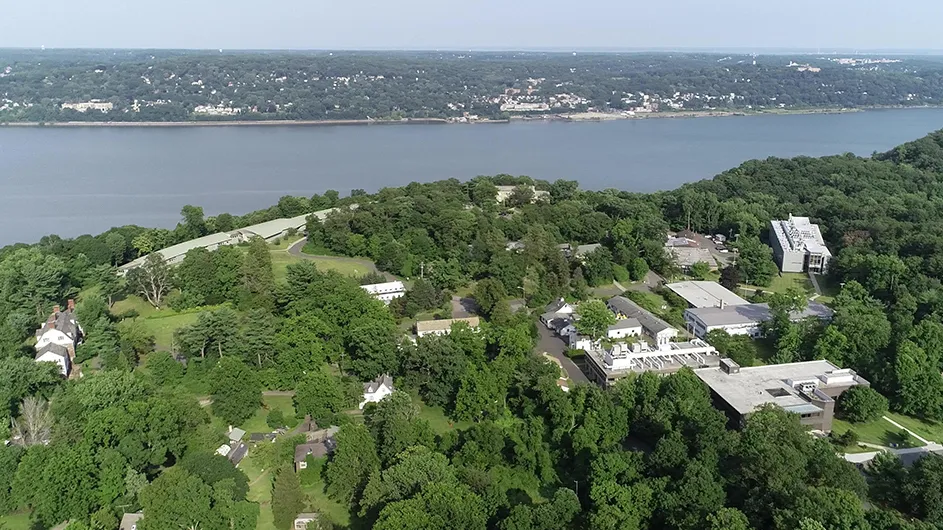
Yesterday, I had the chance to spend part of the day at Columbia’s oasis-like campus in Rockland County, the Lamont-Doherty Earth Observatory. For 75 years, scientists there have been seeking fundamental knowledge about the origin, evolution, and future of the natural world, which has yielded unparalleled scientific discovery in areas such as plate tectonics, ice age theory, El Niño prediction, and carbon capture. Listening to the next generation of scientists, in addition to our Climate School dean, Dr. Alexis Abramson; Dr. Steve Goldstein, Lamont’s interim director; and Dr. David Goldberg, the deputy director, I was reminded, as always, of the excellence that is Columbia. I also found Lamont emblematic of a unique and core Columbia ethos, one which is deeply interdisciplinary, and one in which questions of real-world translation are often asked alongside the pursuit of fundamental knowledge.
Dr. Ajit Subramaniam, who focuses on phytoplankton physiology, among other things, is also engaged in a long-running project with native communities in Alaska to better understand marine ecosystem changes that they are experiencing. Dr. Marco Tedesco’s work spans research on ice sheet dynamics to the economics of climate change, and he also works with both the Data Science Institute and the Business School. Dr. Yutian Wu discussed interactions between the atmosphere and Arctic sea ice and teaches environmental policy at the School of International and Public Affairs. Dr. Jacky Austermann, whose work focuses on the development and melting of continental ice sheets and their effect on land elevation and sea level through time to better understand our present and future climate, also leads projects in Greenland to help coastal communities plan for their changing environment. Dr. Beizhan Yan, with entrepreneurial gusto, has created a group of Columbia scientists, as well as scholars focused on policy, to lead groundbreaking collaborative research on measuring microplastics and nanoplastics in New York City waterways and air, investigating their links to adverse health outcomes—and is developing engineering solutions to mitigate plastic pollution at the same time. These are the Columbia stories that matter.
I was also able to join Columbia University Irving Medical Center’s acting chief executive officer, Dr. James McKiernan, and our colleagues at the medical center on Thursday for a faculty forum. It was heartening to hear the deep relief in the community as grants have been restored and renewed after our resolution with the government; scores of our researchers are resuming their groundbreaking work with more certainty. There were myriad questions not only about the agreement, but also the broader challenges that remain in terms of scientific funding, and we will continue to do the hard work and careful strategic planning and investment to support a thriving research community.
I will be meeting with other groups of faculty and staff this month, whose insights and opinions are critical for the work ahead. I’ve heard from many in our community in the last week, who, understandably, have questions about the resolution, its impact, and what comes next. My office and the senior leadership team have been actively engaged in answering as many of these questions as we can, in consultation with our deans and other faculty and staff leaders. To make sure we reach as wide an audience as possible, we have published a frequently asked questions section on the Our Resolution With the Federal Government page. These are based on the feedback we’ve been hearing from students, faculty, and staff from across the University. We will continue to update them, and if you have additional questions on this or other issues, please email [email protected].
I look forward to seeing you on campus as we all plan for the new academic year.
Sincerely,
Claire Shipman
Acting President, Columbia University in the City of New York